Preparing Incident Personnel to Serve in ICS Supervisory Positions
Preparing Incident Personnel to Serve in ICS Supervisory Positions
The Incident Command System (ICS) Position Specific training program builds the specialized leadership needed to manage complex emergencies. This mission-critical program equips supervisory personnel with the exact skills, communication tools, and decision-making abilities required for high-stakes roles. By mastering these targeted competencies, responders earn the credentials necessary to lead under pressure and safeguard communities.
Success on the ground begins with rigorous preparation. Before starting ICS Position Specific training, personnel must build a foundation by completing prerequisites including ICS training, IS-0201.a (Incident Action Plan Forms) and IS-0995 (ICS Position Foundations). This foundational training prepares students for a demanding, performance-based and scenario driven classroom ICS Position Specific course that builds competency to fill a specific supervisory position within an ICS Organization. ICS Position Specific training is a component of NQS Position qualification.
What is ICS Position Specific?
ICS Position Specific training provides initial position training as a part of position qualification. Each ICS Position Specific course includes position responsibilities, leadership, communication and completion of position specific tasks. There are 21 ICS Position Specific courses that cover 25 separate ICS positions.
The ICS Position Specific training is for supervisory positions within an ICS organization. FEMA NDEMU has not developed training for non-supervisory positions or individual resources.
The majority of ICS Position Specific courses are delivered by individual agencies/jurisdictions and are not routinely delivered by FEMA.
Questions relating to the program should be referred to your State, Territorial or tribal Training Officer or the Position Specific Training Program at e-mail: [email protected]
Prerequisites
There are 7 standard prerequisites which apply to all of the ICS Position Specific courses. Additionally, courses E/L/G 0191, O 305, and O 337 are recommended, but not required.
Students must complete the following 6 independent study courses and 1 classroom course prior to seeking enrollment in any ICS Position Specific course: IS-0100, IS-0200, IS-0201.a, ICS 300 (E/L/G 0300), IS-0700, IS-0800, IS-0995
Many of the ICS Position Specific courses additionally require ICS 400 (E/L/G 400) classrom course. This is noted separately for each applicable course.
-
Introduction to the Incident Command System, ICS 100
IS-0100
Any version
-
Basic Incident Command System for Initial Response, ICS-200
IS-0200
Any version
-
Forms Used for the Development of the Incident Action Plan and Incident Management
IS-0201.a
Version IS-201.a or later
-
Intermediate Incident Command System for Expanding Incidents
ICS-300
Any version
-
Advanced Incident Command System for Complex Incidents
ICS-400
Any version (Not applicable to every course. Check course details.)
-
An Introduction to the National Incident Management System
IS-0700
Any version
-
National Response Framework, An Introduction
IS-0800
Any version
-
ICS Position Foundations
IS-0995
Any version
-
Emergency Operations Center/Incident Command System Interface
ELG-0191
Any version
-
Type 3 All-Hazards Incident Management Team
O-305
Any version
-
Command and General Staff Functions for Local Incident Management Teams
O-337
Any version
Incident Commander Training
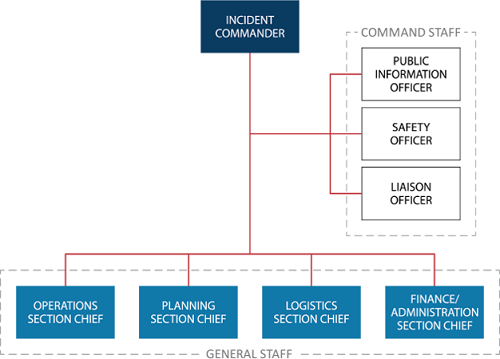
The Incident Commander is responsible for overall incident management, including setting incident objectives and strategies, ensuring responder and public safety, establishing the incident organization, and approving the Incident Action Plan and demobilization plan. They lead and coordinate the Command and General Staff, manage resources, and ensure that incident operations align with the direction and priorities set by the Agency Administrator.
NIMS ICS Incident Commander
ELK4950
This 4-day professional development course gives local and state emergency responders an overview of the key duties and responsibilities of an Incident Commander within an Incident Command System Organization.
ICS Command Staff Training
The ICS Command Staff consists of the Public Information Officer, Safety Officer, Liaison Officer, and any designated advisors who report directly to the Incident Commander. They support overall incident management by handling public information, monitoring and promoting responder safety, coordinating with assisting and cooperating agencies, and providing specialized advice as needed.
NDEMU offers training for the following Command Staff positions:
The Public Information Officer (PIO) is responsible for gathering, verifying, coordinating, and disseminating accurate, accessible, and timely information about the incident to internal and external audiences, including the public and media. The PIO supports incident leadership by coordinating messaging, monitoring media and social media, and supporting the Joint Information System and Joint Information Center.
NIMS ICS Public Information Officer Course
EL0952
This 5-day course provides federal, state, tribal, territorial, and local emergency responders with an overview of the key duties and responsibilities of a Public Information Officer assigned to a Type 3 All Hazards Incident Management Team.
The Safety Officer monitors incident operations and advises the Incident Commander or Unified Command on all matters related to responder health and safety. The Safety Officer develops the incident Safety Plan, identifies and mitigates hazards, and has authority to stop or prevent unsafe acts during incident operations.
NIMS ICS Safety Officer Course
ELK0954
This 5-day course provides federal, state, tribal, and local emergency responders with an overview of the key duties and responsibilities of a Safety Officer in a Type 3 All Hazards Incident Management Team.
The Liaison Officer serves as the primary point of contact at the incident for representatives of assisting and cooperating agencies and organizations. The Liaison Officer facilitates interagency coordination by sharing information on policies, capabilities, limitations, and resource status between incident command and external partners.
NIMS ICS Liaison Officer Course
EL0956
This 2-day course provides federal, state, tribal, and local emergency responders with an overview of the key duties and responsibilities of a Liaison Officer on a Type 3 All Hazards Incident Management Team.
ICS General Staff Training
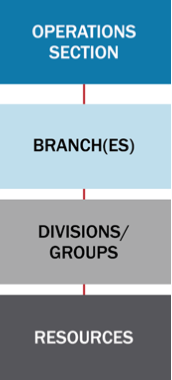
The ICS General Staff is responsible for the major functional areas of incident management and typically includes the Operations, Planning, Logistics, and Finance/Administration Section Chiefs, and, in some incidents, an Intelligence/Investigations function. They manage tactical operations, situation and resource status, support and services, and incident finances to implement the Incident Commander’s objectives.
NDEMU offers training for the following General Staff Positions:
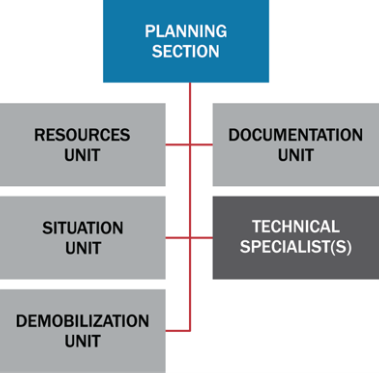
Planning Section Positions include: Planning Section Chief, Resources Unit Leader, Situation Unit Leader, Demobilization Unit Leader, Documentation Unit Leader
The Planning Section collects, evaluates, and disseminates incident information and maintains the status of resources. It facilitates the incident action planning process, prepares the Incident Action Plan (IAP) for each operational period, produces situation reports, incident maps, and projections, and plans for resource demobilization. It may also host technical specialists who support analysis and forecasting.
Planning Section Chief
The Planning Section Chief is responsible for collecting, evaluating, and disseminating incident information and for developing the Incident Action Plan for each operational period. The Planning Section Chief manages the planning process, tracks resource status and incident status, and oversees planning support functions such as situation, documentation, and demobilization.
NIMS ICS Planning Section Chief Course
ELK4962
This 4-day course provides local and state emergency responders with a robust understanding of the duties, responsibilities, and capabilities of an effective Planning Section Chief on an All Hazards Incident Management Team.
Resources and Demobilization Unit Leaders
The Resources Unit Leader tracks and maintains the status of all resources assigned to the incident, while the Demobilization Unit Leader develops and implements the Incident Demobilization Plan. Together, these unit leaders support effective resource management throughout the incident life cycle.
NIMS ICS Resources and Demobilization Unit Leaders Course
EL0965
This 4-day course provides federal, state, and local emergency responders with an overview of key duties and responsibilities of both the Resources Unit Leader and Demobilization Unit Leader in a Type 3 All Hazards Incident Management Team.
Situation Unit Leader
The Situation Unit Leader manages the collection, analysis, and display of incident information, including preparing situation reports and maps and maintaining situational awareness products. The Situation Unit Leader supports incident decision making by providing up to date information on incident status and projections.
NIMS ICS Situation Unit Leader Course
EL0964
This 5-day course helps participants establish the essential core competencies required for performing the duties of a Situation Unit Leader in an all hazards incident.
Documentation Unit Leader
ELK4993
Logistics Section Positions include: Logistics Section Chief, Communications Unit Leader, Medical Unit Leader, Supply Unit Leader, Facilities Unit Leader, Ground Support Unit Leader
The Logistics Section provides all support and service resources needed for incident operations. It is responsible for ordering, receiving, and distributing personnel, equipment, and supplies, establishing and maintaining incident facilities, providing ground transportation, food, and responder medical services, and designing and maintaining communications and IT support so that incident personnel can operate effectively.
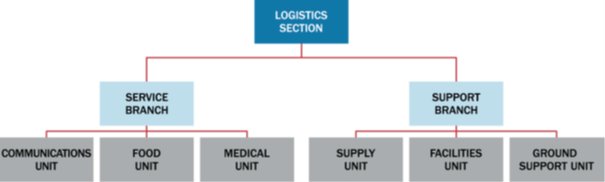 NDEMU offers the following training for the ICS Logistics Section:
Logistics Section Chief
The Logistics Section Chief provides all support needs for the incident, including facilities, transportation, communications, supplies, equipment maintenance and fueling, food, and medical services for incident personnel. The Logistics Section Chief manages logistics planning and resource support so that operations can be sustained safely and efficiently.
NIMS ICS Logistics Section Chief Course
ELK4967
This 5-day course provides federal, state, and local emergency responders with an overview of key duties and responsibilities of a Logistics Section Chief Type 3 in a Type 3 All Hazards Incident Management Team.
Communications Unit Leader (COML)
The COML is responsible for developing and implementing the Incident Radio Communications Plan and managing all incident communications systems, including radios and data networks. The COML ensures that incident personnel have interoperable and reliable communications to support operations and incident support activities.
NIMS ICS Communications Unit Leader Course
ELK4969
This 4-day course helps participants establish the core competencies required to perform the duties of a Communications Unit Leader in an all hazards incident.
Supply Unit Leader
The Supply Unit Leader orders, receives, stores, and distributes all incident related supplies and equipment and maintains inventories of non-expendable items. The Supply Unit Leader supports all sections by ensuring that needed supplies and equipment are acquired, tracked, and recovered.
NIMS ICS Supply Unit Leader Course
EL0970
This 5-day course provides federal, state, and local emergency responders with an overview of the key duties and responsibilities of a Supply Unit Leader Type 3 in a Type 3 All Hazards Incident Management Team.
Facilities Unit Leader
The Facilities Unit Leader establishes, maintains, and demobilizes all incident support facilities such as the Incident Command Post, base, and camps. The Facilities Unit Leader coordinates facility services such as shelter, sanitation, and security to support incident personnel.
NIMS ICS Facilities Unit Leader Course
EL0971
This 5-day course provides federal, state, and local emergency responders with an overview of key duties and responsibilities of a Facilities Unit Leader Type 3 in a Type 3 All Hazards Incident Management Team.
NIMS ICS Medical Unit Leader
ELK4992
Ground Support Unit Leader
ELK4994
Finance/ Administration Section Positions: Finance/Administration Section Chief, Compensation/Claims Unit Leader, Procurement Unit Leader, Cost Unit Leader, Time Unit Leader
The Finance/Administration Section manages the financial, administrative, and cost analysis aspects of the incident. Its responsibilities include tracking and reporting costs, managing contracts and procurement, handling personnel time records, and administering claims and compensation related to injuries, property damage, and other liabilities, to ensure compliance with applicable laws and policies and support reimbursement processes.
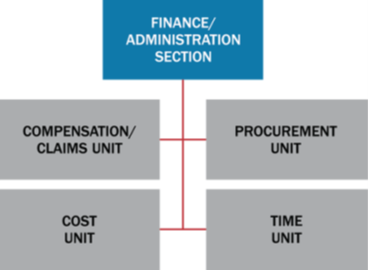 NDEMU offers the following training for the ICS Finance/Administration Section:
Finance/Administration Section Chief
The Finance/Administration Section Chief manages all financial and administrative aspects of an incident, including cost tracking, timekeeping, procurement, and claims. The section chief ensures compliance with applicable policies and provides cost analysis and fiscal guidance to incident leadership.
NIMS ICS Finance/Administration Section Chief Course
EL0973
This 3-day course provides federal, state, and local emergency responders with an overview of key duties and responsibilities of a Finance/Administration Section Chief in a Type 3 All Hazards Incident Management Team.
Finance/Administration Unit Leader
Finance/Administration Unit Leaders manage specific functional areas such as time, procurement, compensation and claims, and cost within the Finance/Administration Section. These leaders ensure that detailed records are kept and that financial processes support incident operations.
NIMS ICS Finance/Administration Unit Leader Course
EL0975
This 3-day course provides federal, state, and local emergency responders with an overview of the key duties and responsibilities of the four Finance/Administration Unit Leader Type 3 positions in a Type 3 All Hazards Incident Management Team.
Intelligence/ Investigations Section Positions include: Intelligence/Investigations Section Chief, Division/Group Supervisor
The intelligence/investigations function focuses on determining the source or cause of the incident and supporting efforts to prevent or deter future occurrences. Depending on incident needs, it may be integrated into the Planning Section, Operations Section, Command Staff, or established as a separate General Staff section. Its activities include collecting, analyzing, and sharing threat and investigative information, managing evidence and forensic processes, supporting law enforcement and epidemiological investigations, and informing operational decisions to enhance responder and public safety.
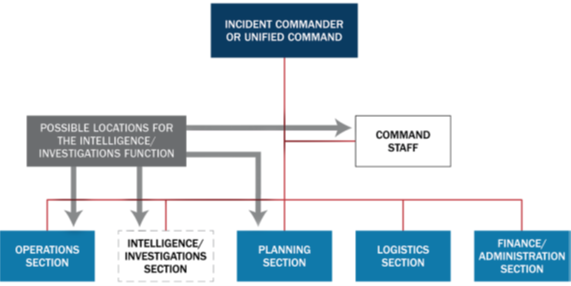 NDEMU offers the following training for the ICS Intelligence/ Investigations Section:
Division/Group Supervisor
The Division/Group Supervisor is responsible for managing tactical operations within a defined geographic area (division) or functional area (group), implementing the Assignment List, and supervising assigned resources. When Intelligence/ Investigations is established as a Section, its subordinate components are organized as functional Groups. The supervisor coordinates with adjacent divisions or groups, reports progress, and ensures that tactics are executed safely.
NIMS ICS Division/Group Supervisor Course
EL0960
This 3-day course provides responders from local, tribal, state, federal, and private organizations with an overview of key duties and responsibilities of a Division/Group Supervisor for incidents of all types from Type 4 through Type 1.
Intelligence/Investigations Section Chief
ELK4991
Need Help?
Not sure if this training fits your requirements?
NIMS training delivery is a decentralized, collaborative effort that can be tricky to navigate. Try our Who requires what training? section or contact NIMS training program for specific questions.