
Training Based on ICS Role and Incident Complexity
Training Based on ICS Role and Incident Complexity
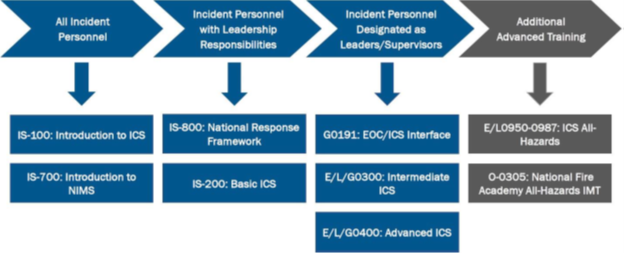
The NDEMU ICS training section outlines a progressive curriculum designed to equip personnel with a shared structure and clear processes for multi-agency collaboration, with progression determined by individual roles and incident complexity. Users start with foundational courses (IS-100/IS-700) and advance to specialized leadership training (E/L/G0300-0400) based on their responsibilities.
Personnel who will operate within ICS (field personnel) follow the ICS training progression. Each AHJ determines how far individuals need to progress based on their role within ICS and the size and complexity of the incident.
What is ICS?
ICS provides a common hierarchy, terminology, and set of processes for command, control, and coordination at the incident site, enabling personnel from multiple agencies and disciplines to work together effectively. Under ICS, an Incident Commander or Unified Command sets incident objectives, and the organization expands modularly into functional sections (Operations, Planning, Logistics, Finance/Administration, and, as needed, Intelligence/Investigations) to manage resources, direct tactical actions, and achieve incident objectives safely and efficiently.
Progressive Training for ICS Incident Field Personnel
This level covers nonsupervisory personnel and provides foundational training so they understand NIMS/ICS concepts and where they fit in the overall incident structure; many personnel will only need this baseline level.
-
Introduction to the Incident Command System, ICS 100
IS-0100
A 2-hour independent study course that explains the history, features, principles, and basic organizational structure of ICS and how it relates to the National Incident Management System (NIMS).
-
An Introduction to the National Incident Management System
IS-0700
This 3.5-hour independent study course provides an overview of the National Incident Management System (NIMS), which defines the comprehensive approach used by the whole community—including all levels of government, nongovernmental organizations, and the private sector—to work together to prevent, protect against, mitigate, respond to, and recover from incidents. It gives learners a basic understanding of NIMS concepts, principles, and components.
Personnel with Leadership Responsibilities
This level is for mid-level personnel who may establish initial incident command or are preparing for supervisory roles, giving them additional background on incident management systems and how to apply NIMS/ICS as leaders.
-
Basic Incident Command System for Initial Response, ICS-200
IS-0200
This 4-hour course reviews the Incident Command System (ICS), provides the context for ICS within initial response, and supports higher level ICS training. This course provides training on, and resources for, personnel who are likely to assume a supervisory position within ICS.
-
National Response Framework, An Introduction
IS-0800
A 3-hour independent study course that provides guidance for the whole community on the National Response Framework, with a special focus on people involved in delivering and applying response core capabilities, such as private sector partners, non-governmental organizations (NGOs), government officials, community leaders, emergency management practitioners, and first responders.
Leaders/Supervisors
This level is for senior personnel formally assigned as ICS leaders/supervisors for larger or more complex incidents, and focuses on advanced use of NIMS structures, processes, and tools to manage extended operations and develop Incident Action Plans.
-
Emergency Operations Center/Incident Command System Interface
ELG0191
A 1-day classroom professional development course that teaches students how to create an effective working relationship between the Incident Command/Unified Command and the Emergency Operations Center using National Incident Management System principles.
-
Intermediate Incident Command System for Expanding Incidents - ICS 300
ELG0300
This 3-day classroom course trains personnel who will serve as supervisors within an incident command organization and need practical instruction on applying the Incident Command System (ICS).
-
Advanced Incident Command System for Complex Incidents - ICS 400
ELG0400
This 2-day classroom course provides advanced training in the Incident Command System (ICS) for senior personnel who are expected to serve in Incident Command or Command and General Staff positions for complex incidents requiring a large incident command organization and extensive multi-agency coordination. ICS 400 is not designed for personnel filling Unit Leader, Task Force/ Strike Team Leader or individual resource positions within an ICS Organization. The course builds on material from ICS 100 through ICS 300 and is focused on organizational approaches to reducing incident complexity.
Need Help?
Not sure if this training fits your requirements?
NIMS training delivery is a decentralized, collaborative effort that can be tricky to navigate. Try our Who requires what training? section or contact NIMS training program for specific questions.